
Summer ABA Therapy in Miami: How to Prevent Skill Regression
Why the long summer break is the riskiest time for your child’s progress — and how to protect every hard-won skill.

Summer ABA therapy in Miami is one of the smartest investments a family can make during the long break, because the months between school years are exactly when hard-won skills are most likely to slip away. After a year of steady progress in Applied Behavior Analysis (ABA) therapy, many parents assume summer is the time to pause and relax. In reality, an unstructured summer is often where months of growth quietly unravel, and a structured summer is where children make some of their biggest leaps forward.
At Mayoral Behavioral Services, we see this pattern every year. Children who stay engaged over the summer return to school in the fall confident, regulated, and ready to learn. Children who go three months without structure or therapy often spend the first weeks of the new school year relearning skills they had already mastered. This guide explains what summer skill regression is, why it hits children in Miami-Dade, Broward, and the Tampa area especially hard, and exactly how summer ABA therapy in Miami protects your child’s progress, with practical strategies your whole family can start using today.
- What Summer Skill Regression Really Is
- Why Summer Is the Riskiest Season for Miami Children
- How Summer ABA Therapy Prevents Regression
- 7 Summer Strategies Parents Can Use at Home
- How Summer ABA Therapy Works at Mayoral Behavioral Services
- Signs Your Child May Be Regressing
- Frequently Asked Questions
- Summer skill regression is the loss of previously learned skills during long breaks, and it is well documented in children with autism and developmental differences.
- Consistency is the antidote: keeping ABA therapy going over the summer preserves communication, social, and daily-living skills.
- Summer’s relaxed pace is actually an advantage, giving therapists more time to target real-world goals like community outings and play.
- Simple home routines, visual schedules, and built-in practice keep skills sharp between sessions.
- Watch for early warning signs of regression, such as fading communication or returning challenging behaviors, and act quickly.
- Mayoral Behavioral Services offers flexible in-home, in-clinic, and telehealth summer ABA therapy across Miami-Dade, Broward, and Tampa.
What Summer Skill Regression Really Is
Skill regression means losing abilities a child has already learned. In the context of behavioral therapy, it shows up when a child who could request items with words starts pointing and crying again, when a child who was sleeping through the night returns to nighttime struggles, or when challenging behaviors that had faded suddenly reappear. Regression is not a sign that your child has failed, and it is certainly not a sign that you have. It is a natural response to a sudden loss of structure, practice, and routine.
Educators have long recognized a related phenomenon called the summer slide, the measurable academic loss that many children experience over the break. The Centers for Disease Control and Prevention and the American Academy of Pediatrics both emphasize that consistency and routine are protective factors for child development. For children receiving ABA therapy, the stakes are higher and the loss can be faster, because the skills being built, such as communication, self-regulation, and social interaction, depend on frequent, deliberate practice to become permanent.
The encouraging news is that regression is largely preventable. When children with autism spectrum disorder and other developmental differences continue to practice their skills in a structured way over the summer, those skills hold steady and often grow. Prevention simply requires a plan, and summer ABA therapy in Miami is that plan.
Why Summer Is the Riskiest Season for Miami Children
Three months may not sound like a long time, but for a young child building foundational skills, it is enormous. Several factors make the Miami summer especially challenging for families of children in therapy.
The loss of school structure. During the school year, children benefit from predictable routines, built-in social opportunities, and constant practice of communication and self-help skills. When school ends, that scaffolding disappears overnight. Without a replacement structure, many children drift, and their skills drift with them.
Miami’s heat keeps families indoors. Summer in South Florida means intense heat, humidity, and frequent afternoon storms. Long stretches indoors with limited activity can increase boredom, screen time, and challenging behaviors, while reducing the natural opportunities children have to practice social and communication skills with peers.
Disrupted schedules and travel. Family vacations, visiting relatives, and changing sleep patterns all add unpredictability. Children who thrive on routine can find these disruptions destabilizing, which makes maintaining their therapy goals even more important, not less.
Fewer natural social opportunities. The classroom is a built-in social environment. Over the summer, many children lose regular contact with peers, which can stall progress on social skills like sharing, turn-taking, and conversation. The Autism Society highlights structured social engagement as a key support for children on the spectrum, and summer is when that engagement is hardest to come by without a plan.

How Summer ABA Therapy Prevents Regression
Summer ABA therapy works by replacing the structure that school provides with consistent, individualized practice tailored to your child’s goals. Rather than letting skills sit unused for three months, therapy keeps them active, reinforced, and growing. Here is how that protection works in practice.
It maintains consistency. The single most powerful factor in preventing regression is consistency. Regular sessions, even at a reduced summer schedule, give your child ongoing opportunities to use and strengthen their skills. A skill that is practiced weekly stays sharp, while a skill left untouched for a season fades.
It turns summer freedom into an advantage. The slower summer pace is not just a risk, it is an opportunity. Without the demands of homework and early school mornings, your behavioral therapy team can focus on real-world goals that are hard to target during the school year, such as ordering at a restaurant, navigating a grocery store, playing at a park, or building independence in daily routines. These naturalistic settings are where skills truly generalize.
It supports the whole family. Summer ABA therapy is also a chance to strengthen parent training and support. With family schedules often more flexible in summer, parents and caregivers can be more involved in sessions, learning strategies they will carry through the school year and beyond.
It keeps challenging behaviors in check. Boredom and lost structure are common triggers for challenging behaviors. By keeping your child engaged in purposeful, motivating activities, summer therapy reduces the downtime where difficult behaviors tend to creep back in.
7 Summer Strategies Parents Can Use at Home
Therapy sessions are powerful, but the hours in between are where skills are won or lost. These seven strategies help Miami families reinforce progress at home all summer long. Your child’s Board Certified Behavior Analyst (BCBA), a clinician with specialized training in behavior science, can tailor each one to your child’s specific goals.
1. Keep a Predictable Daily Routine
Children thrive on predictability, especially when school structure disappears. Build a simple, consistent summer schedule with regular times for waking, meals, activities, and bed. A loose rhythm to the day, even on lazy summer mornings, gives your child the security and structure that protects their skills.
2. Use a Visual Schedule
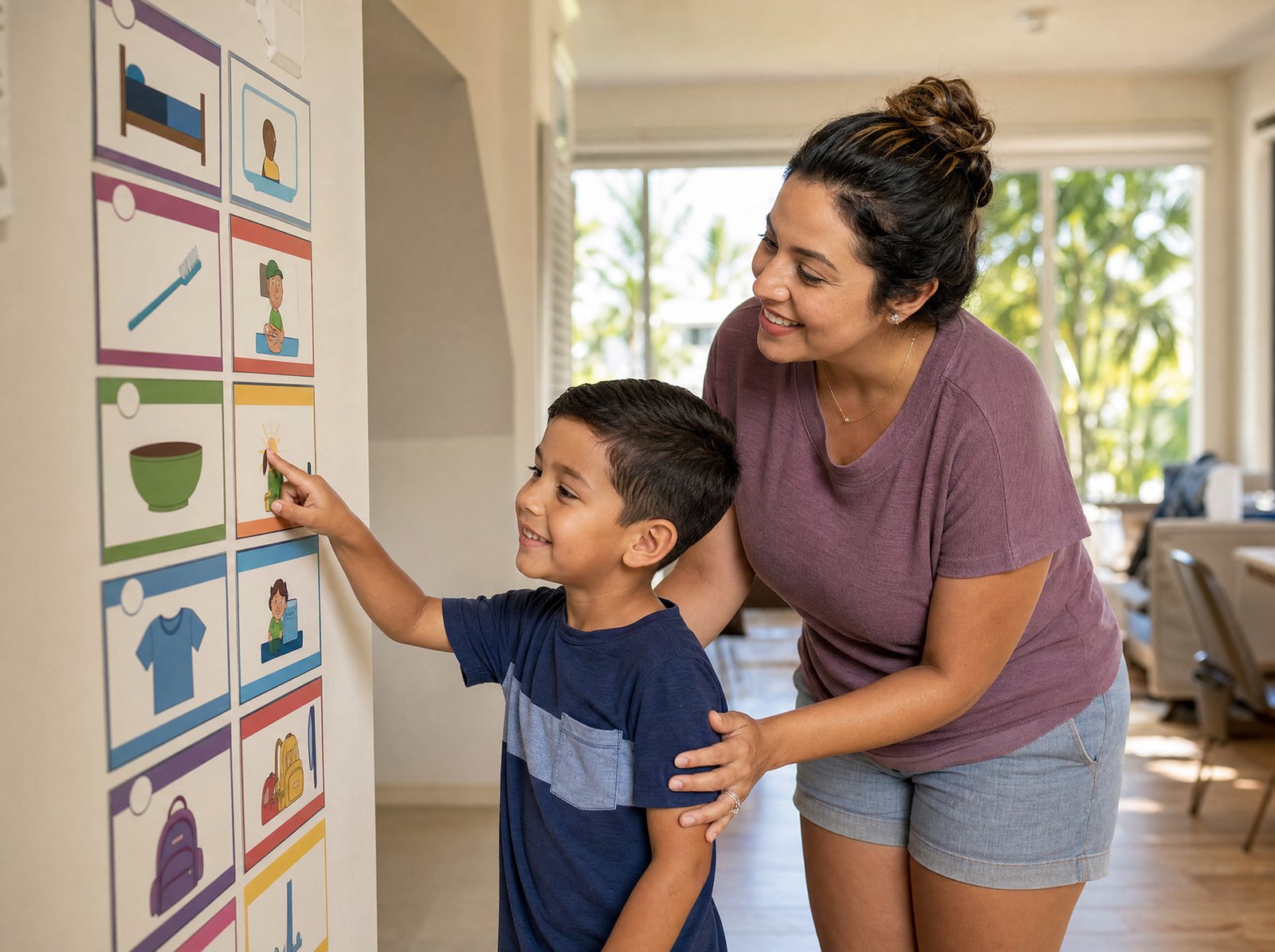
A visual schedule, using pictures or simple words, helps your child understand what is coming next and eases the anxiety of unstructured days. Post it where your child can see it and review it together each morning. Visual supports reduce meltdowns around transitions and reinforce independence.
3. Build Practice Into Everyday Moments
You do not need flashcards to keep skills sharp. A trip to the grocery store builds requesting, counting, and waiting. Cooking together encourages following directions and communication. A walk in the neighborhood becomes a chance to label what you see. Embedding practice in real life keeps it meaningful and motivating.
4. Protect Social Connection
With school friendships on pause, create intentional social opportunities. Arrange short, structured playdates, sign up for an inclusive summer program, or simply practice turn-taking through family games. Even brief, positive peer interactions help maintain the social skills your child has worked so hard to build.
5. Keep Reinforcement Positive and Consistent
Reinforcement is the engine of ABA. When your child uses a skill, follow it immediately with specific praise or a motivating reward. Instead of a vague good job, try I love how you asked for the water with your words. Consistent, genuine reinforcement encourages your child to keep using their skills.
6. Limit Unstructured Screen Time
Long, passive stretches of screen time can crowd out the active practice your child needs. You do not have to eliminate screens, but balance them with movement, play, and interaction. Use screen time intentionally, and pair it with communication when you can, such as having your child request a favorite show.
7. Stay Connected With Your Therapy Team
Your BCBA is your partner all summer. Share what you are seeing at home, ask questions between sessions, and request simple strategies for trips or disruptions. Staying in close contact ensures small concerns are addressed before they become setbacks.
How Summer ABA Therapy Works at Mayoral Behavioral Services
At Mayoral Behavioral Services, summer ABA therapy is designed around your family’s real life. We know summers in Miami are busy, hot, and full of change, so our approach is built to be flexible without sacrificing consistency. Families across Miami-Dade, Broward, and the Tampa area can expect a program shaped around their child, not a one-size-fits-all schedule.
It begins with your child’s individualized treatment plan. Your BCBA reviews the goals your child has been working toward and identifies which skills are most at risk over the summer and which are ready to grow. Summer goals often shift toward real-world independence, community skills, and social connection, taking advantage of the season’s flexibility.
Next, we build a schedule that fits your summer. Therapy can take place in your home, at our Miami office, or through secure telehealth, and the intensity can flex around travel and family plans. Even a maintained summer schedule, lighter than the school year if needed, is enough to prevent regression and keep momentum.
Throughout the summer, we keep families closely involved. Parent training is woven into the work, so the strategies your child practices in session are reinforced at home. When fall arrives, your child returns to school steady and confident, and you carry a deeper toolkit into the new year. Families just beginning to explore ABA therapy in Miami often find that summer is the ideal, lower-pressure time to start.

Signs Your Child May Be Regressing
Catching regression early makes it far easier to reverse. Watch for these warning signs over the summer, and reach out to your therapy team if you notice them.
Communication is fading. Your child uses fewer words, signs, or device messages than before, or returns to gestures and crying to get needs met. Communication skills are often the first to slip.
Challenging behaviors are returning. Tantrums, aggression, or self-stimulatory behaviors that had decreased begin to reappear or intensify. This often signals that your child has lost the structure or skills they were relying on.
Independence is slipping. Daily-living skills like dressing, toileting, or feeding that your child had mastered suddenly need more prompting and support again.
Social withdrawal. Your child shows less interest in interacting, struggles with peers in ways they had moved past, or avoids social situations they previously enjoyed. The National Institute of Mental Health notes that early, consistent intervention produces the strongest outcomes, so acting at the first sign matters.
If you recognize any of these patterns, do not wait for the school year to start. A quick adjustment to your child’s summer plan can stop regression in its tracks and protect the progress your family has worked so hard to achieve. You can learn more about local services and supports through the Florida Department of Health.
Mayoral Behavioral Services offers flexible summer ABA therapy across Miami-Dade, Broward, and Tampa, with in-home, in-clinic, and telehealth options that fit your family’s summer. Let’s build a plan that protects every skill your child has earned.
Frequently Asked Questions
What is summer skill regression?
Summer skill regression is the loss of previously learned skills during the long break from school and structured routines. For children in ABA therapy, this can mean fading communication, returning challenging behaviors, or lost independence. It is common and well documented, but it is also largely preventable with consistent summer support.
Does my child really need ABA therapy over the summer?
Continuing therapy over the summer is one of the most effective ways to prevent regression. Even a lighter summer schedule maintains consistency and keeps skills active. Summer’s relaxed pace also creates ideal opportunities to practice real-world goals like community outings and social play, so many children make excellent progress during these months.
How many hours of summer ABA therapy are recommended?
There is no single answer, because the right amount depends on your child’s individual treatment plan and goals. Your BCBA will recommend a summer schedule that maintains progress while fitting your family’s plans. The priority is consistency, so even a maintained, flexible schedule is far better than a full pause.
Can summer ABA therapy work around our vacation or travel plans?
Yes. At Mayoral Behavioral Services, summer schedules are built to flex around travel, camps, and family plans. We offer in-home, in-clinic, and telehealth options, and your team can provide simple strategies to keep skills strong even while you are away.
What can I do at home to prevent regression?
Keep a predictable daily routine, use a visual schedule, build practice into everyday activities like cooking and shopping, protect social connection with playdates or programs, and stay in close contact with your therapy team. Consistent positive reinforcement and limited unstructured screen time also make a meaningful difference.
Is summer ABA therapy covered by insurance in Florida?
In many cases, yes. ABA therapy is commonly covered by private insurance and Florida Medicaid for children with a qualifying diagnosis, and coverage generally continues year-round, including summer. Coverage varies by plan, so our team is happy to help you verify your benefits before you begin.